
How to Check Criminal History in Crosby County
A complete Crosby County search is a set of targeted checks, not one name query. First decide whether the goal is to learn about an arrest, confirm current custody, read a filed case, verify a conviction, or review your own fingerprint-linked record. Gather a full legal name, date of birth when the office accepts it, an approximate event or filing year, and any report, booking, citation, cause, or state identification number. Spelling variants and aliases help when a name has changed.
Use the narrowest official custodian first. Crosby County felony cases go to the District Clerk. Class A and B misdemeanor cases go to the County Clerk. City and justice courts retain their fine-only cases. The Sheriff handles county arrest, booking, jail, and warrant records. Texas DPS supplies the statewide public conviction and deferred-adjudication product, while a fingerprint review is the sound route for checking your own Texas history.
- Identify the record type, event place, arresting agency, and likely court level.
- Call the custodian to confirm its search method, public counter access, current hours, copy cost, and preferred request channel.
- Give a name, date range, and known report, booking, citation, or cause number. Ask for the exact item, not an answer to a broad question.
- Compare the booking entry with the clerk's filed charge and disposition. They may differ.
- Order a certified disposition or a DPS fingerprint review when identity or the official outcome must be resolved.
For a local starting point, the Crosby County government directory links the Sheriff, District Clerk, County Clerk, court, and prosecutor pages. The screenshot below shows that department-first structure.
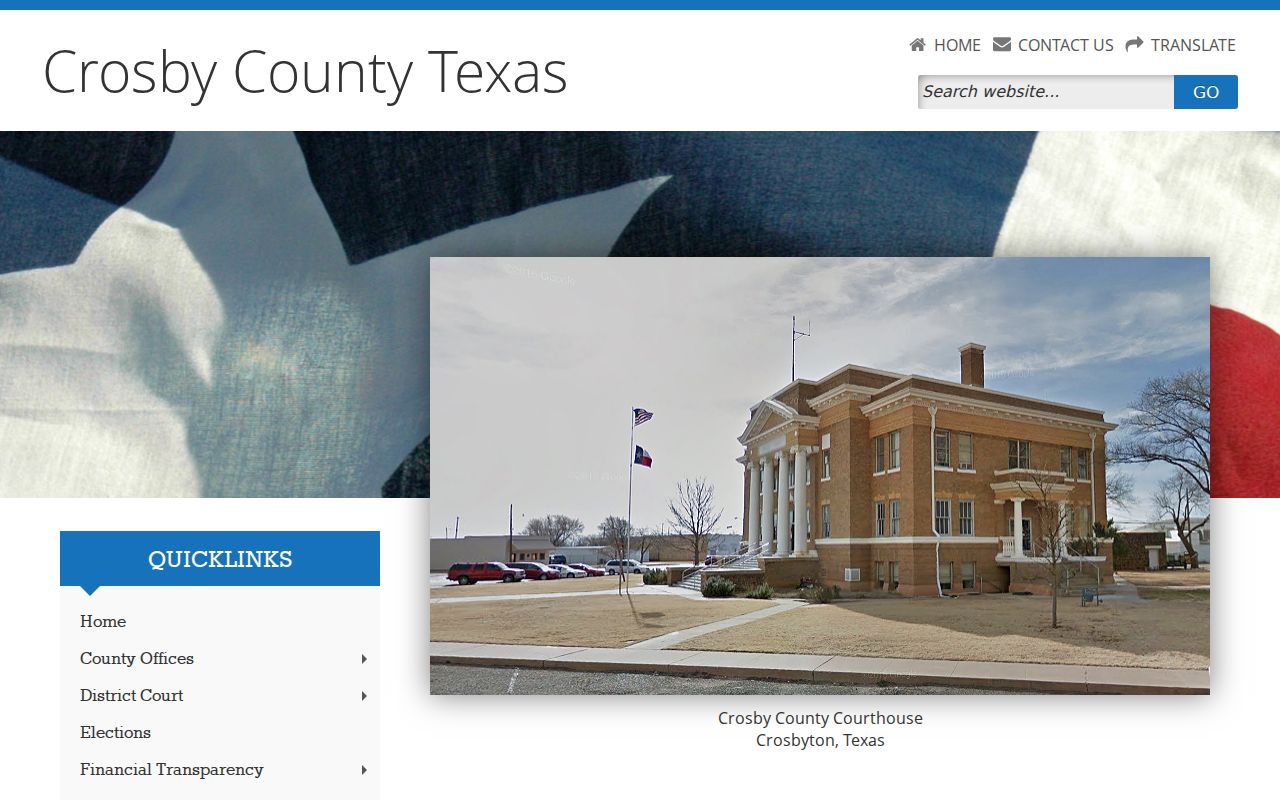
The county directory is useful for routing, but it does not provide a combined criminal-record search.
No One-Stop Crosby Criminal Search
A no-result screen is weak evidence in Crosby County. The county publishes no local criminal-case portal, jail roster, daily booking log, warrant database, sheriff request form, or police blotter. The County Clerk uses KiCorp as its case-management system, according to the state court directory, but no public KiCorp link is posted. Texas also has no single complete statewide trial-court criminal index.
Record ownership explains the gap. A city officer can create an incident report. The Crosby County Sheriff can create a booking file. A prosecutor can file a different or narrower charge. A clerk then opens a court file, and the court later reports a disposition to DPS. Each office holds a piece. Search timing also matters. A fresh arrest may not yet have a filed case, and a court result may not yet have reached the state system.
| Question | First official channel | Fallback |
|---|---|---|
| Was someone booked locally? | Texas VINELink | Sheriff call and written booking request |
| What was filed as a felony? | District Clerk, Suite 207 | Manual or archived index search |
| What was filed as a Class A or B misdemeanor? | County Clerk, Suite 102 | Counter, mail, phone, or clerk email |
| Is there a public Texas conviction entry? | DPS CCH name search | Fingerprint personal review and certified disposition |
Note: A portal miss does not prove that Crosby County has no record.
Official Texas Background Checks
The Texas DPS Criminal History Conviction Search is the public name-based product. It reports public Texas convictions and deferred adjudications based on data agencies have submitted to the Computerized Criminal History system. Users register and buy search credits. Each online credit costs $1. Card orders add 2.25 percent per credit and $0.25 per transaction. A search uses a credit even when it returns no match, and opening another full possible-match record uses another credit.
That product does not prove identity. Similar names, Soundex matches, birth dates, and descriptive data can help narrow a result, but DPS states that fingerprints are the positive link. For self-review, DPS lists a $15 fingerprint record-review fee plus a $10 FAST collection fee. Appointments run through Fingerprint Applicant Services of Texas at IdentoGO or by phone at 1-888-467-2080. A stable Crosby County enrollment site was not found, so the live locator should be checked with the correct service code and ZIP before travel.
The official IdentoGO enrollment interface illustrates the live appointment route used for a fingerprint-based Crosby County and Texas self-review.
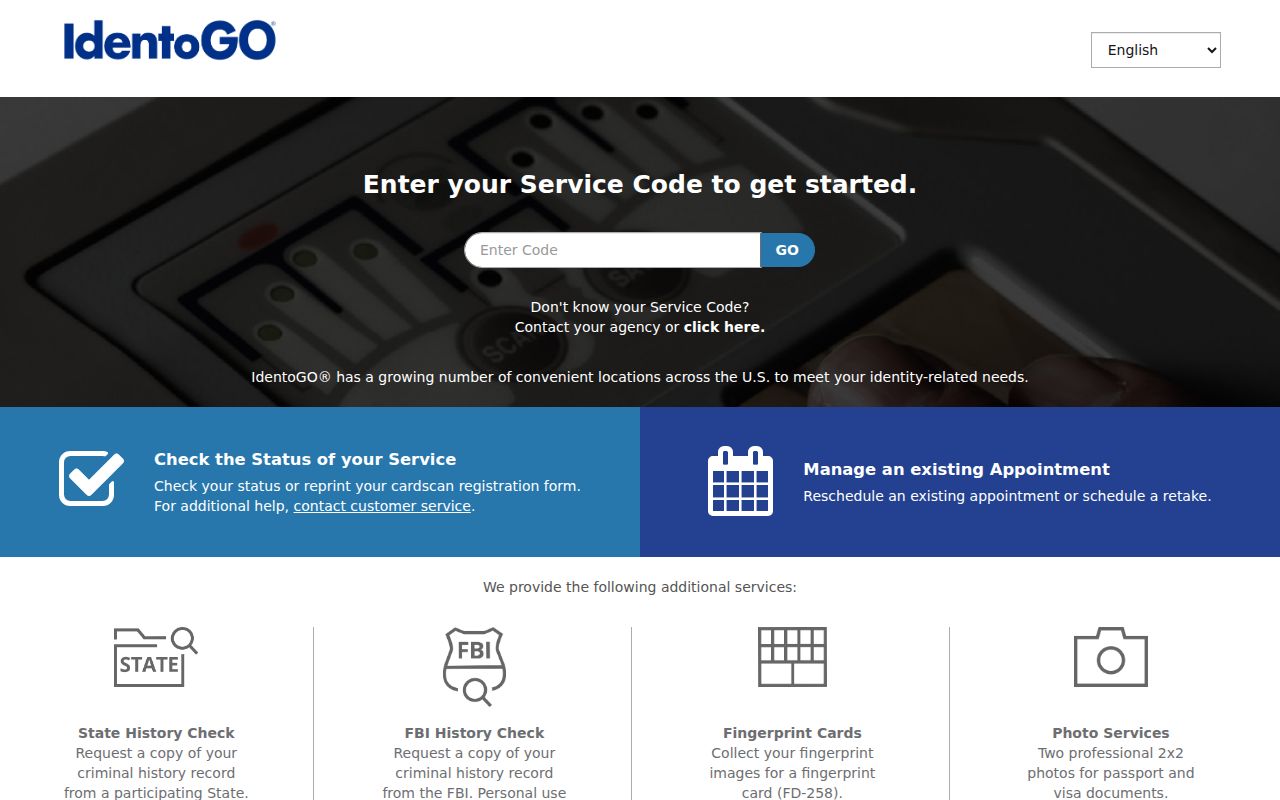
The live locator is more reliable than assuming a fixed nearby collection site.
Search Crosby Records in DPS CCH
DPS CCH is useful when the question reaches beyond one Crosby County clerk. It can show public reportable convictions and deferred adjudications from across Texas. It is not a copy of the sheriff's booking file or a certified local judgment. Start with the most exact identity data available, preview a possible match, and open the full record only after comparing the displayed descriptors. A false match and a missing disposition are both possible.
| Search control | Use | Caution |
|---|---|---|
| Last and first name | Required name fields | Aliases and spelling variants may matter |
| Middle name | Narrows a common name | Optional |
| Date of birth | Strong match aid | Still not fingerprint identity |
| Sex and race | Optional narrowing controls | Use only to compare possible matches |
| Exact Match or Soundex | Controls name similarity | Soundex may return like-sounding names |
| Preview and Full Record | Compare before debit | Each opened full record costs a credit |
The Texas DPS Crime Records Division landing page is the state gateway shown below.
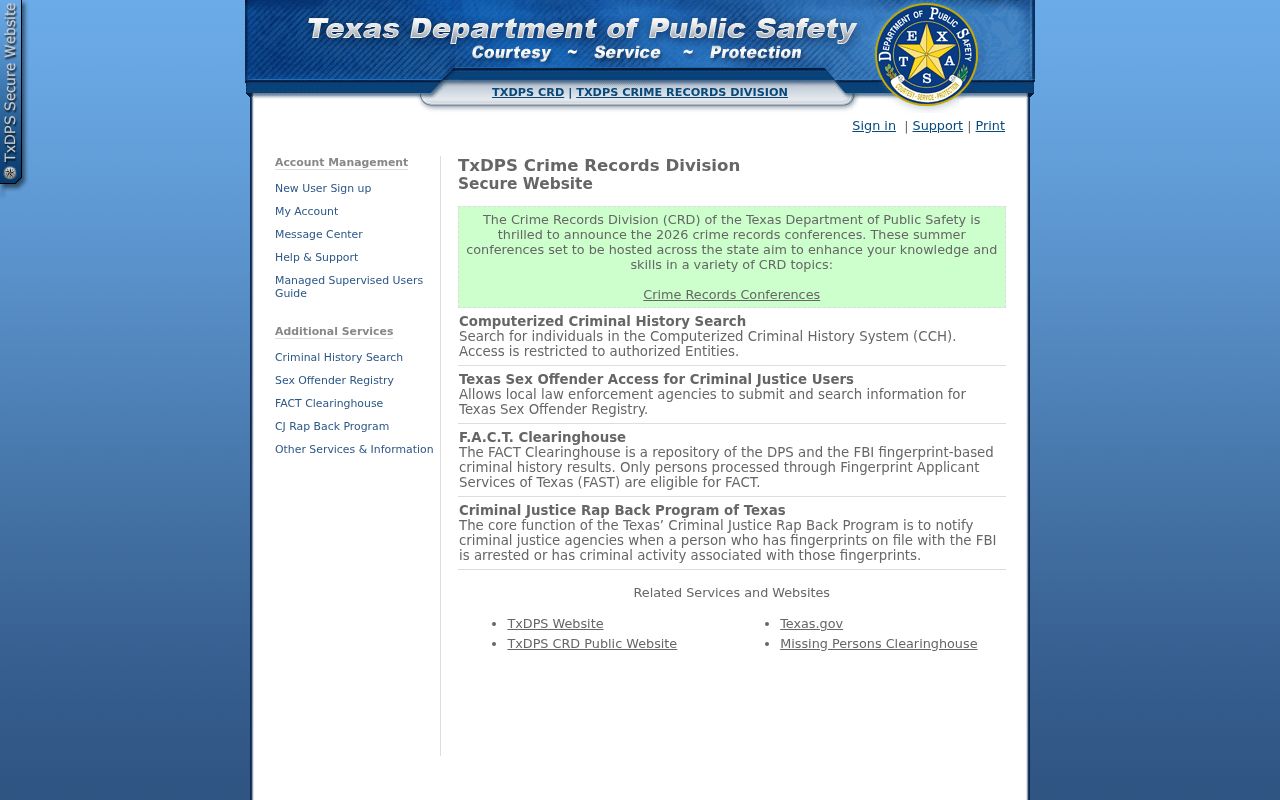
Use the DPS result as a statewide layer, then return to the Crosby County clerk for the court's certified outcome.
Types of Criminal Records
Crosby County records follow the event from report through custody and court. The incident or arrest report describes the officer's work and alleged offense. A booking record tracks jail intake, charge, bond, fingerprints, and release. The prosecutor's complaint, information, or indictment states what the government chose to file. The case docket and judgment show how the court resolved it.
- Reports and bookings: the originating police agency holds its report, while the Sheriff holds county jail intake and custody data.
- Court cases: the District Clerk holds felonies, the County Clerk holds Class A and B misdemeanors, and municipal or justice clerks hold fine-only matters.
- Warrants: the issuing court creates the process, while law enforcement handles service and execution status.
- State history: DPS builds reportable fingerprint cycles and court outcomes into CCH.
- Custody and supervision: the Sheriff covers local custody, TDCJ covers state prison and parole, and local CSCD staff handle community supervision.
- Registry records: local authorities register qualifying people and Texas DPS publishes permitted Chapter 62 fields.
Texas law ordinarily places Class B and more serious arrest cycles into CCH reporting. A fine-only Class C city case may therefore remain at the municipal or justice level and never appear in the same way.
Crosby Criminal Records Since 1914
The physical record system grew around the Crosby County Courthouse at 201 W. Aspen Street in Crosbyton. The Texas Historical Commission courthouse history explains that Crosbyton won the county-seat election, Julian Bassett donated the site, and county court met in a schoolhouse until the courthouse and jail were built in 1914. The Classical Revival building remains the county's criminal-record hub.
Modern searchers still move among distinct custodians in that one location. The County Clerk's misdemeanor counter is in Suite 102. The District Clerk's felony counter is in Suite 207. The Sheriff, prosecutor, and other county officials are also tied to the courthouse address in official listings. Shared geography does not merge their records. A request for a police narrative, booking sheet, charging instrument, or judgment still goes to a different custodian.
The Commission's official courthouse image shows the building that anchors Crosby County criminal record access.
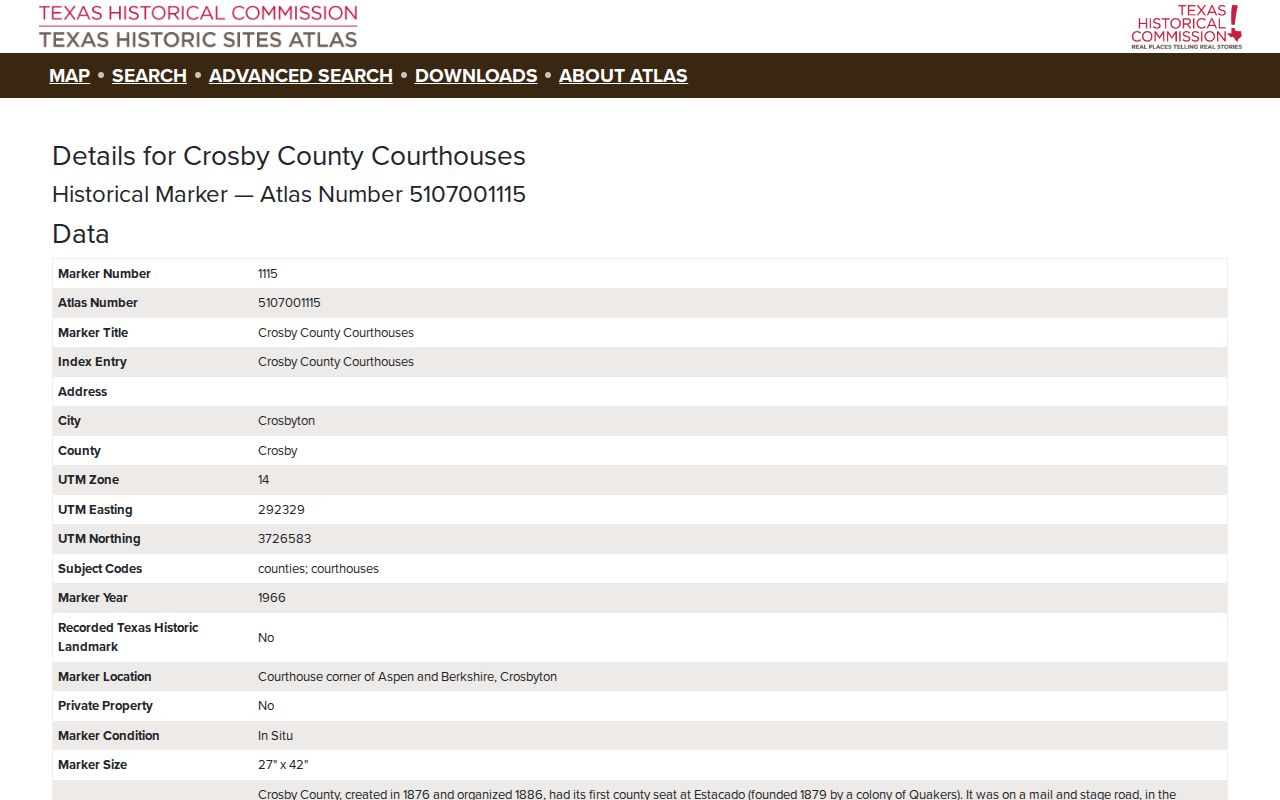
The history helps explain why direct clerk and sheriff contact remains more useful than searching for an unverified local portal.
What a Crosby County Criminal Record Shows
The fields depend on who made the record. A Crosby County booking is custody-centered. It may list an intake date, arresting agency, initial charge, booking identifier, bond, fingerprints, photograph, magistrate action, and release. A case file is cause-centered. It can list the court, cause number, parties, filed charge, statute and class, attorneys, event register, hearings, pleas, orders, disposition, judgment, sentence, and costs.
| Name and identifiers | Legal name, aliases, birth date, descriptive data, SID or FBI number when part of the authorized record. |
|---|---|
| Arrest and booking | Agency, event and booking dates, preliminary charge, custody, bond, and release data. |
| Filed charges | Complaint, information, or indictment, offense statute, class, and later amendments. |
| Disposition | Conviction, deferred adjudication, dismissal, acquittal, no-bill, or other recorded outcome. |
| Sentence | Jail or prison term, fine, restitution, community supervision, and related orders when public. |
| Custody or supervision | County custody, TDCJ unit and release data, or the court's public supervision order. |
Preliminary charges can be amended, rejected, or replaced. The clerk's final judgment is the better source for outcome, while a certified copy gives the strongest local proof.
Two Crosby Clerks, Two Case Levels
Choosing the wrong clerk is a common Crosby County delay. District Clerk Shari Smith holds 72nd District Court felony files. Her office is at 201 W. Aspen Street, Suite 207, Crosbyton, TX 79322; call 806-675-2071, fax 806-675-2433, or email dc72nd@crosbycountytx.com. Ask for the criminal index, docket, charging document, judgment, or certified disposition. The District Clerk can also explain current filing practice for an expunction tied to a district case.
County Clerk Tammy Marshall holds Crosby County Court Class A and B misdemeanor files in Suite 102 at the same address. Call 806-675-2334, fax 806-675-2980, or use countyclerk1@crosbycountytx.com or countyclerk2@crosbycountytx.com. The state directory verifies KiCorp as this office's case-management system, but no public search endpoint is posted.
District Clerk
201 W. Aspen Street, Suite 207
Crosbyton, TX 79322
806-675-2071
Felony case files and certified outcomes
County Clerk
201 W. Aspen Street, Suite 102
Crosbyton, TX 79322
806-675-2334
Class A and B misdemeanor files
Crosby County Sheriff
201 W. Aspen Street
Crosbyton, TX 79322
806-675-7301
Arrest, booking, custody, and warrant routing
Municipal and justice cases form a third level. Crosbyton Municipal Court, for example, handles ordinance and fine-only state-law cases rather than felony files.
Public Access Laws
The correct access rule turns on the record. A written request to the Sheriff or a city police department can trigger the Texas Public Information Act. Court case files go through the clerk under court-access law, not the ordinary agency-request process. DPS criminal-history dissemination has its own limits. Protected data may be redacted, and active investigations, juvenile material, sealed documents, victim identifiers, medical data, Social Security numbers, and driver-license data may be withheld.
Key Texas laws:
Government Code Chapter 552 gives the public a written-request route to agency records and sets prompt-production and ruling duties.
Government Code Sections 411.083 and 411.135 govern criminal-history access and the DPS public conviction and deferred-adjudication product.
Code of Criminal Procedure Chapter 66 controls reportable arrest, prosecution, and disposition data sent to CCH.
Texas Rule of Judicial Administration 12 covers judicial administrative records, while adjudicative case files remain with the clerk.
Code of Criminal Procedure Chapter 55A is the current Texas expunction chapter.
The Texas Attorney General open-government hub provides the official request framework pictured below.

A focused request should name the record, date range, agency, desired format, and known identifiers. A phone call helps route it, but only a written request triggers TPIA duties.
Crosby Booking Checks Through VINELink
The Crosby County Sheriff publishes no jail roster or booking blotter. Its official page refers readers to Texas VINELink for custody status and notification. That makes VINELink the best public first step for a recent county custody question, but it is an alert and status tool, not the full arrest report or booking file.
Search the current or recent custody layer, then call the Sheriff at 806-675-7301 to confirm the person, arresting agency, booking number, current status, and the method for obtaining public booking details. If the arrest began with Crosbyton, Ralls, or Lorenzo police, request the incident narrative from that city. After prosecutors file, move to the correct clerk. For a full treatment of this split, see the Crosby County arrest history resource.
Record flow: Arresting agency › Sheriff booking › prosecutor › county or district clerk › Texas DPS CCH.
Note: VINELink can confirm a custody event without supplying the final filed charge or judgment.
Sealed, Expunged & Restricted
Texas expunction and nondisclosure do different work. An expunction under Chapter 55A can order removal or destruction of qualifying records within its scope. Eligibility can depend on the full arrest episode, dismissal or no-bill timing, acquittal, pardon, identity error, limitations periods, and statutory exceptions. A nondisclosure order generally restricts public release of qualifying history while preserving access for agencies listed by law. It is not destruction.
Crosby County publishes no local form or fee for either route. A person should ask the clerk tied to the case about the current petition path, filing cost, service list, hearing procedure, and certified-order fee. The 2025 recodification moved Texas expunction law from old Chapter 55 to Chapter 55A, so an old form should not be reused without checking it. After an order, certified copies help with follow-up to the clerk, Sheriff, arresting agency, and DPS.
- Expunction
- A court-ordered Texas remedy that removes or destroys qualifying records within the order's reach.
- Nondisclosure
- A Texas order that limits public disclosure but keeps defined government access.
- Disposition
- The recorded court outcome, such as conviction, dismissal, or acquittal.
- No-bill
- A grand jury decision not to return an indictment.
- Deferred adjudication
- Supervision without an immediate finding of guilt, subject to the court's terms.
Fix a Crosby Disposition in DPS
A DPS record can show an arrest cycle without the expected court outcome when reporting is late or incomplete. Start by locating the Crosby County case at the correct clerk. Ask for a certified disposition that identifies the cause, filed charge, and final result. Compare names, dates, and state identifiers carefully. Then follow the Texas DPS Error Resolution process and provide the certified court material the unit requests.
The court and DPS perform separate corrections. The clerk controls its case record. DPS controls CCH. If the issue also appears in a sheriff booking or city report, that custodian may need its own copy of the order or disposition. A name-based public search should not be treated as proof that every system has changed. A later fingerprint personal review is the stronger way to check your own state record after the agencies process the correction.
Crosby County Warrant Record Routes
Crosby County has no public active-warrant database or county most-wanted list. Start with the issuing level. Call the Sheriff at 806-675-7301 about county or district arrest-warrant execution status. Check the District or County Clerk for a related filed case. Contact the municipal court that issued a city failure-to-appear warrant or capias, and use the Justice Court for its own process. Texas has no general public statewide warrant search.
A warrant file can identify a person, cause or warrant number, issue date, alleged offense, court, bond, and status. Some warrants, sealed indictments, and juvenile process are not public. Do not rely on an old list or assume that payment alone clears a warrant at once. Confirm the court's current resolution method and get written clearance. For surrender or bond questions, use the issuing court, counsel, and Sheriff instead of acting on an unverified web result.
Criminal Records by City in Crosby County
Ralls, Crosbyton, and Lorenzo form Crosby County's three incorporated municipal centers. Their police departments create city reports, and their municipal courts retain city-ordinance or fine-only cases. County booking begins with the Sheriff, while more serious filed cases move to the County or District Clerk. Each city route therefore starts locally and then branches by custody and charge level.
Ralls Criminal History
The county's largest incorporated city; no verified public report or municipal case portal.
Crosbyton Criminal History
The county seat; city court inquiries begin at 221 W. Main before county routing.
Lorenzo Criminal History
The western city route requires current police and court contact verification before travel.
City report, Sheriff booking, clerk case, and DPS history can all describe the same event from different points in time.
Crosby Custody: Jail, TDCJ, BOP
Use the locator that matches the custody level. VINELink and the Crosby County Sheriff cover current or recent local jail status. The TDCJ Online Inmate Search begins after a person enters state custody and can show a TDCJ or SID number, unit, offense, sentence county, sentence length, projected release, and parole data. It does not replace the local booking narrative. The Federal Bureau of Prisons locator covers federal prisoners, not the county jail or TDCJ.
Community supervision, Texas's term for probation, is administered through a county or district CSCD. Crosby County does not post the precise serving office, so the sentencing clerk should identify it from the case. TDCJ Parole Division supervises state parole, while the Texas Board of Pardons and Paroles makes release decisions. Start with the judgment for the public sentence, then use the correct state office for current parole status.
The re:SearchTX interface shown below can help with general Texas court research, but state reports say its large document collection excluded criminal case records.
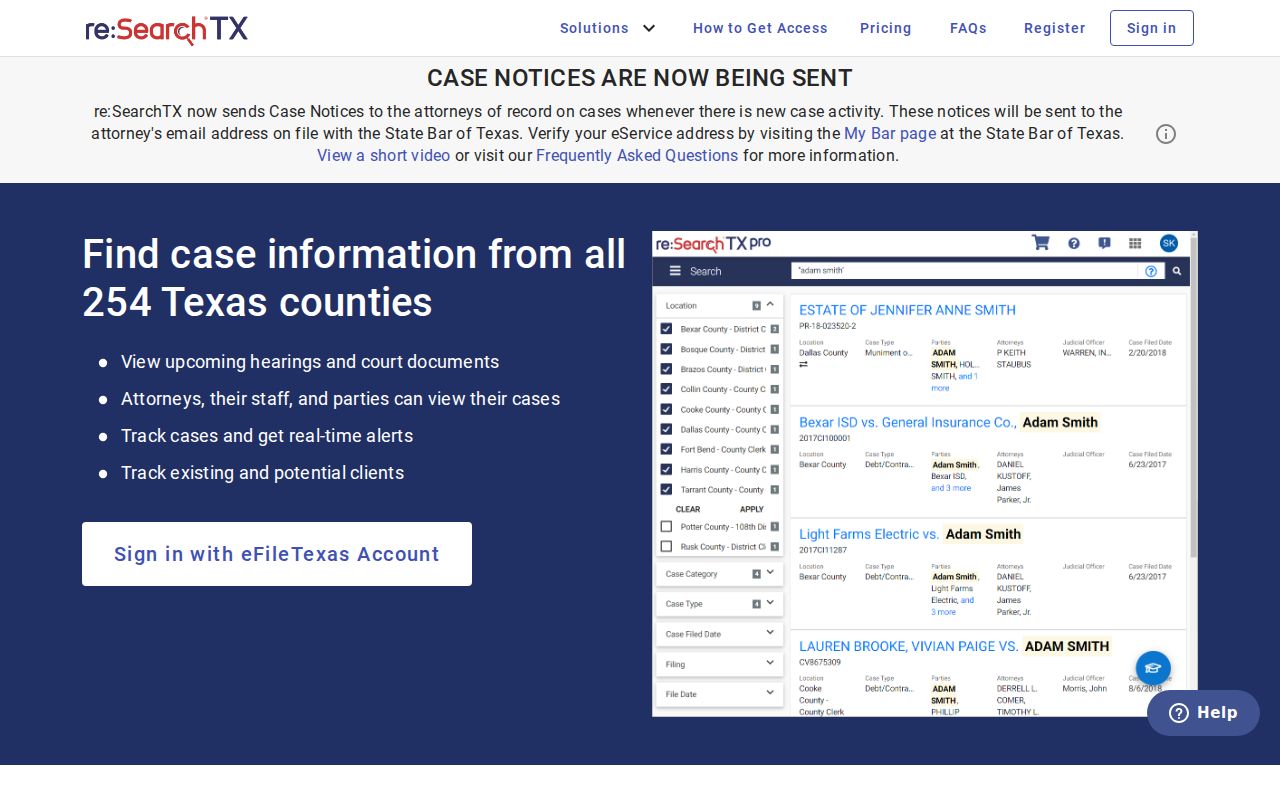
For an authoritative Crosby County criminal case, call the clerk even when re:SearchTX returns no result.